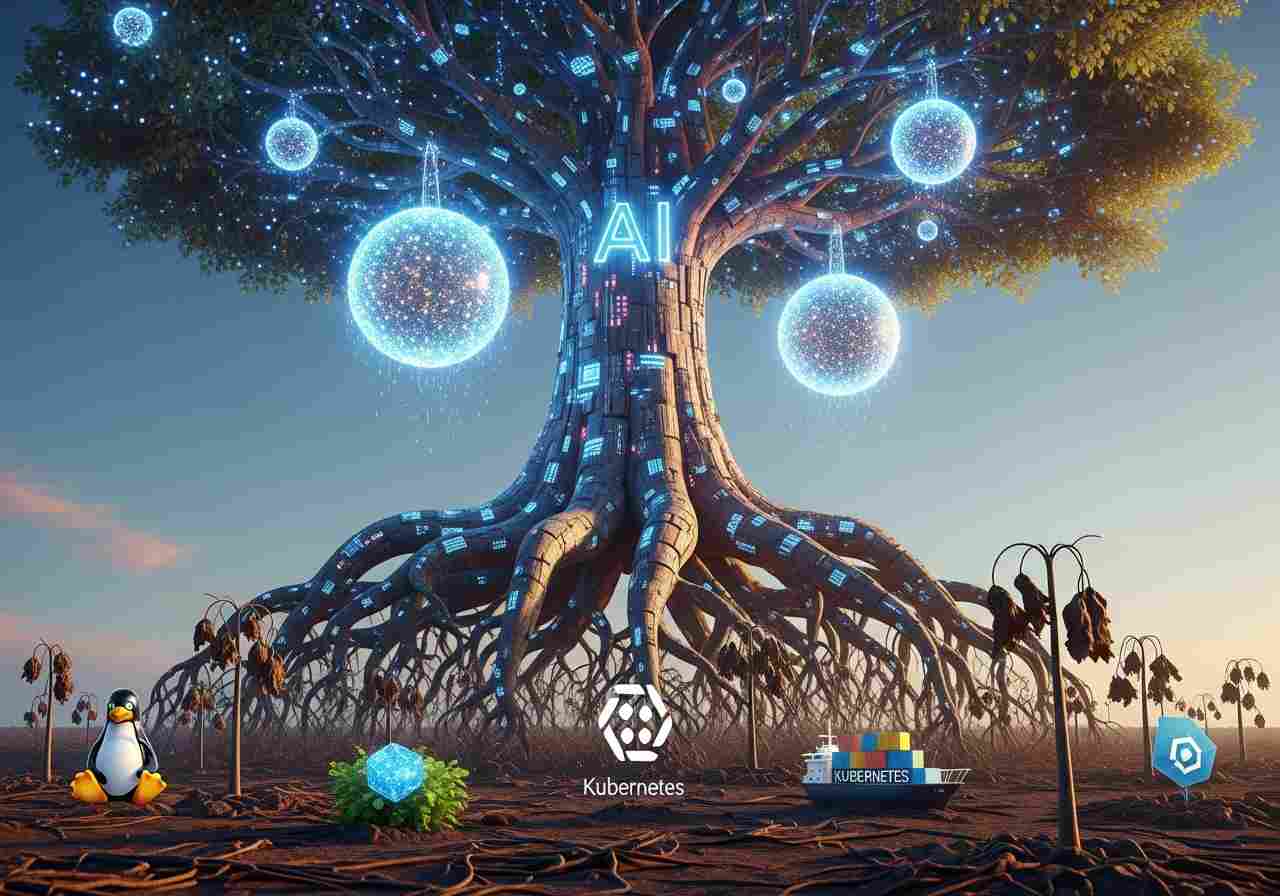
It is unlikely that you consider the open-source code that makes our world work. But it is there, quietly powering every device of your smartphone up to global banking. This machine that has never existed physically depended on the spirit of community. Now, that spirit is fading. A shocking new report by Linux foundation states that there has been a drastic drop in the number of corporate contributions. Concurrently, the never-ending AI supremacy battle is consuming all the air. Why then do the same companies who are relying on this free code suddenly bow out?
This poses a fatalistic paradox to the whole IT industry.
The Data Doesn’t Lie: A Retreat that can Be Measured
We are not merely guessing at it. The figures paint a very grim picture. According to the current report by Linux Foundation, The State of Open Source, the corporate-backed contributions to major projects have decreased by 15 per cent in the past year. In the meantime, a different study by Forrester emphasizes that a majority of companies (60 percent) are feeling burnout of Zero Trust, reducing other important security efforts in IT. These aren’t isolated trends. They are indicative of a bigger company drawback of particular, long-term investment in technology. It has changed its focus dramatically.
The financial resources and talent are moving in a single direction.
A high-level technology director in Google admitted to experiencing a huge inside rearrangement of the highest engineering abilities. The directive is obvious: It is not about refining communal tools, it is about working on our proprietary AI models.
This intra-country movement causes a brain drain. The geniuses that kept open-source libraries on their feet have been swept out of the mainstream and are developing closed systems. The common good is dwindling and individual reservoirs are filling up. This imbalance cannot last.
The A.I. Resource Drain: A Gold Rush in Companies
Why is this happening? Follow the money. The AI boom is a trillion dollar prospect. Firms such as Meta, Google and Apple are all at an arms race. They are attracting their top engineers off of open-source projects and putting them onto their own projects in AI. The creation of models such as Llama 3 or Gemini-1.5 is not only a priority but the sole priority of most IT departments. This leaves a vacuum that is unsustainable.
Take into account the effect in the real world. One of the project leads of a successful data visualization library has just written on Hacker News. He claimed that his corporate sponsors reduced his budget by half. They simply reasoned in this manner. They required such resources in the new AI generative division. The community version of the project is now finding it hard to survive. This is a horror tale that is gaining momentum.
The anonymous engineer wrote in one of the developer forums, My team has created Kubernetes tools. This is now just AI training optimization on the cluster of GPUs. It is more remunerative, but I have the impression that I am making a walled garden.
The Log4Shell Echo: A Dismissed Warning
Let’s be clear about the risk. We’ve seen this movie before. The Log4Shell crisis in 2021 is a thing to remember. An open-source, ubiquitous logging tool had a high vulnerability. It posed a threat to the whole internet. The weakness was that it was a project being run by few overworked volunteers. In an overly ignored dependency, the global IT ecosystem was reduced to its knees. This was a screaming wake-up call.
However, we are pressing the snooze button. Even the corporate entities that Log4Shell panicked are now defunding the maintenance of similar projects. They treat open source not as an infrastructure they must sustain, but as a free product they can devour. This is a disastrous strategic fault. The new Log4Shell is already hanging around in a poorly funded and poorly maintained codebase. And we are less than ever seeking it.
Our digital world security is being rolled dice in the short-term AI benefits.
A Way Forward: Reducing Our Digital Commons
So, what’s the solution? It is time to stop depending on goodwill of corporations. The model is broken. Open-source sustainability should be formalized as an element of the IT and AI supply chain. Imagine it in the form of the electricity grid. Businesses do not simply get to plug into the grid on a free basis, they pay in order to maintain it. The same should be accorded respect to our digital infrastructure.
A number of appealing models are coming up.
- The Tidelift Model: Customers are subscribing to a supported, stable, and maintained stack of their open-source dependencies.
- Open Core: Projects are free base platforms that raise funds by selling enterprise features and support.
- Consortium Funding: Consortia such as the OpenSSF, which are sponsored by various companies, address common security issues.
Adopting these isn’t charity. It is strategic risk management.
A Final, Uncomfortable Truth
The situation is simple. The frenzied rate of AI and IT innovation is founded on the decades of open-source work. And we are now burning that same foundation to fuel. Corporations have been exploiting more than they have given thereby posing an enormous structural risk. Whether it is an absence of technology, the next significant cyber-attack or systemic failure will not happen. It will be as a result of a lapse of stewardship. It is up to us: are we the generation which will create wonders of AI only to see it fall on a decaying digital foundation? Now is the time to invest into our common code and the next crisis is going to leave us no choice.