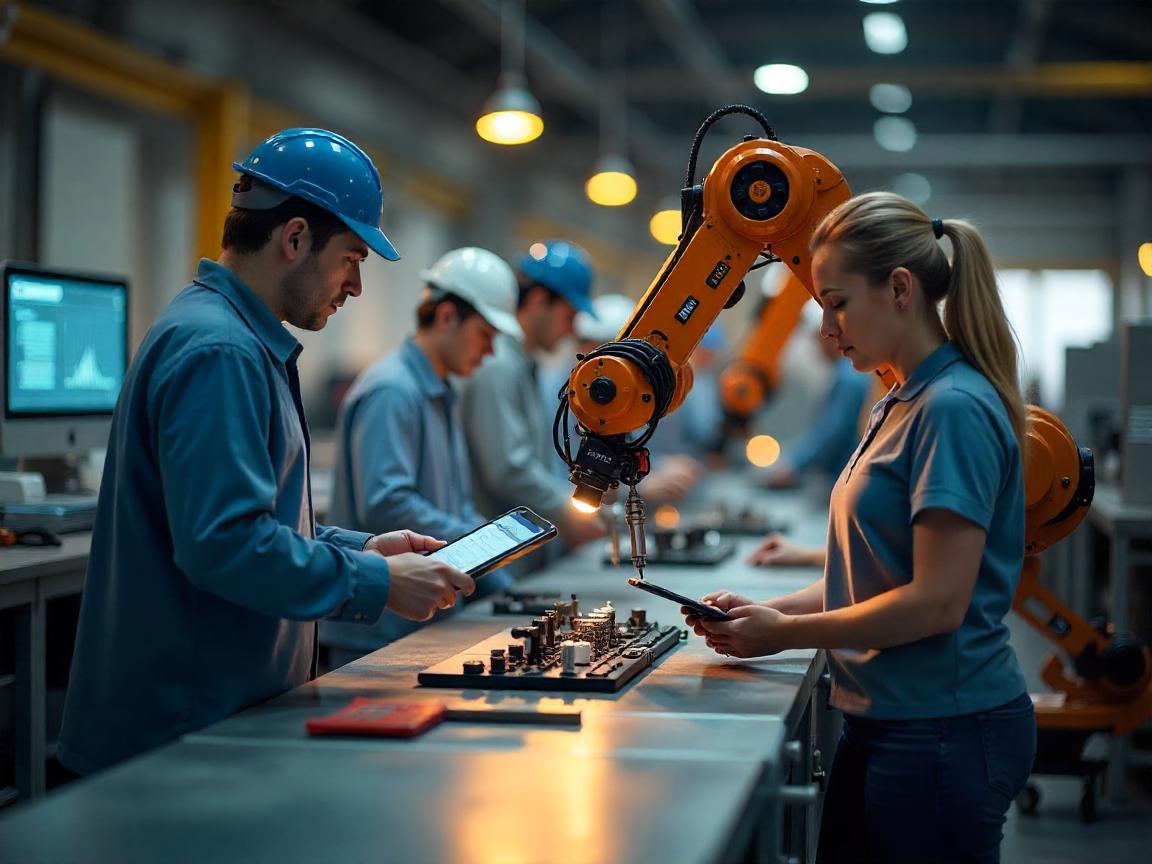
Strategic simplification in robotics: Think of the ease with which an industrial robot could be implemented just like it is done with a wireless printer. This would have been crazy just a few years back when robots were sophisticated, costly and sheltered to the tech giant or the highly educated engineer with a PHD degree. However, today with strategic simplification in robotics we are entering into a new world accessibility. Robots are increasingly becoming present in unexpected places, and without the backing of an armada of engineers: in small-town factories in the U.S. and high-tech farms in Japan.
Breaking Robots into Building Blocks: The Rise of Modular Design
The development of robotics was a maze of custom-made hardware, bespoke software and nightmarish integration procedures that lasted decades. But now? The robotics firms are leveling things down by connecting everything in interchangeable modules as having IKEA-style furniture. Such modules are not only slimmer, but they are also cleverer and more flexible.
Consider Robotnik RB-KAIROS mobile manipulator. The standardized ROS-based platform with an interchangeable arm allows companies to customize it to run the production of tomorrow and logistics in the one after. The greatness is in versatility. According to a recent IEEE Spectrum release, standardised robotics saves more than 40 per cent of the onboarding and long-term maintenance time. That is enormous to the SMEs that run on very thin margins.
Standardization Isn’t Boring—It’s Revolutionary
People may say that innovation is weakened by standardization. It is, however, doing the reverse in robotics. Robotics companies are taking away the friction in the deployment by targeting universal operating systems such as ROS 2, plug-and-play APIs, and hardware connectors fluent to the industry.
Think of Ready Robotics Forge/OS-which is a control platform that enables the operator to operate the arms that belong to other manufacturers (such as Fanuc, ABB, and Yaskawa) but using a single operating interface. Their customers recorded the deployment speed 3-4 times faster than legacy solutions. It is not merely the productivity reward; you can say it is an opening door of robotics to non-technical teams.
To quote what Dr. Henrik Christensen, founder of the Contextual Robotics Institute, stated, by doing this, ‘the innovation can grow exponentially when systems share a common language. By simplicity it does not imply that it is unsophisticated; it is just that more people can engage in it.”
Small Players, Big Wins: How Simplification is Powering SMEs
But the actual beneficiaries of this move are small-to-mid-size enterprises. These industries have been observing the robotics revolution on the periphery waiting until cost and unfeasibility stave them off. However things are quickly changing.
Recently, a MassRobotics case study showed that a nearby Massachusetts-based machining shop implemented a collaborative robot when it did not have any in-house robotics team. Using an already made integration kit and the help of Forge/OS, they were able to install a robot within 36 hours and have an improvement in throughput of 25 percent within three weeks. All the cost? Less than 50,000 (tools, software and training).
These businesses are no longer after tech: what they need is turnkey automation:
- Ready-made AI vision systems
- Drag-and-drop interfaces
- Remote diagnostics and prognostics
and what is most important? The help of a human being on the other end of the telephone.
Real-World Analogy: The PC Revolution of Robotics
We will fast forward to the 80s of the last century. By that time, computers were the size of a room and could only be used by governments and researchers. The next thing was the personal computer which was smaller and cheaper and targeted at the common audience. Sound familiar?
Here is where we are the PC era of robotics. Plug-and-play is not a marketing term and the turning point that scales the use of robotics. And similarly to how PCs provided the possibility to use spreadsheets, emails, and web design, simplified robots are opening up automation to:
- Inventory in retailing
- Last-mile delivery
- Greenhouse management
- Even independent elder care support
During his presentation at CES 2025, Unitree Robotics introduced its fully modular, bipedal robot, which could be fitted with accessories to enhance logistics, security, or cleaning, along with a smartphone app that helps to control this robot. That is not what is going to happen in the future, that is what is happening today.
Expert Insight: “If You’re Not Simplifying, You’re Not Scaling”
As Dr. Andra Keay, the Managing Director of Silicon Valley Robotics, so adorably eloquently put it, Accessibility is not a trend, but a survival strategy. Aincha simplifying? If not you aincha scaling.”
The feeling is shared within the sphere. Under standardization as a differentiator, an April 2025 Robotics Business Review panel found that an overwhelming percentage (72 percent) of robotics startups are making standardization a feature, not a cost-saving component. As the need increases in unmet markets, such as construction, agriculture, eldercare, the competition is not necessarily the most sophisticated robot, but the most employable one.
This feedback is echoed in my personal discussions with a team in Lahore building robots to do autonomous delivery and, as one such team member tells me, the simpler the platform the better it scales. There is no time to reinvent the wheel as one engineer told me. We desire wheels which bolt on and roll at once.
Conclusion: Robots for the Rest of Us
This is the bare bone: Robotics strategic simplification is not about dumbing things down. It is all about expanding the circle. Robotics will be required when it is modular, cheap, and intuitive.
This is no longer an exercise of automating factories. It is about empowering bakeries, farms, clinics and classrooms. And in a world where there are constant shortages of labor sources and cost of doing business has been on the rise this level of availability is not only a welcome addition, it is a necessity.
Strategic simplification in robotics: That way the next time you consider robots, you do not have to consider a futuristic laboratory with blinking lights. Think about your own business. Your neighborhood. Your classroom. And so, in the event that simplification proceeds with such a rate then the following order of robotics would be owned by anybody.
And perhaps therein the most radical of all.