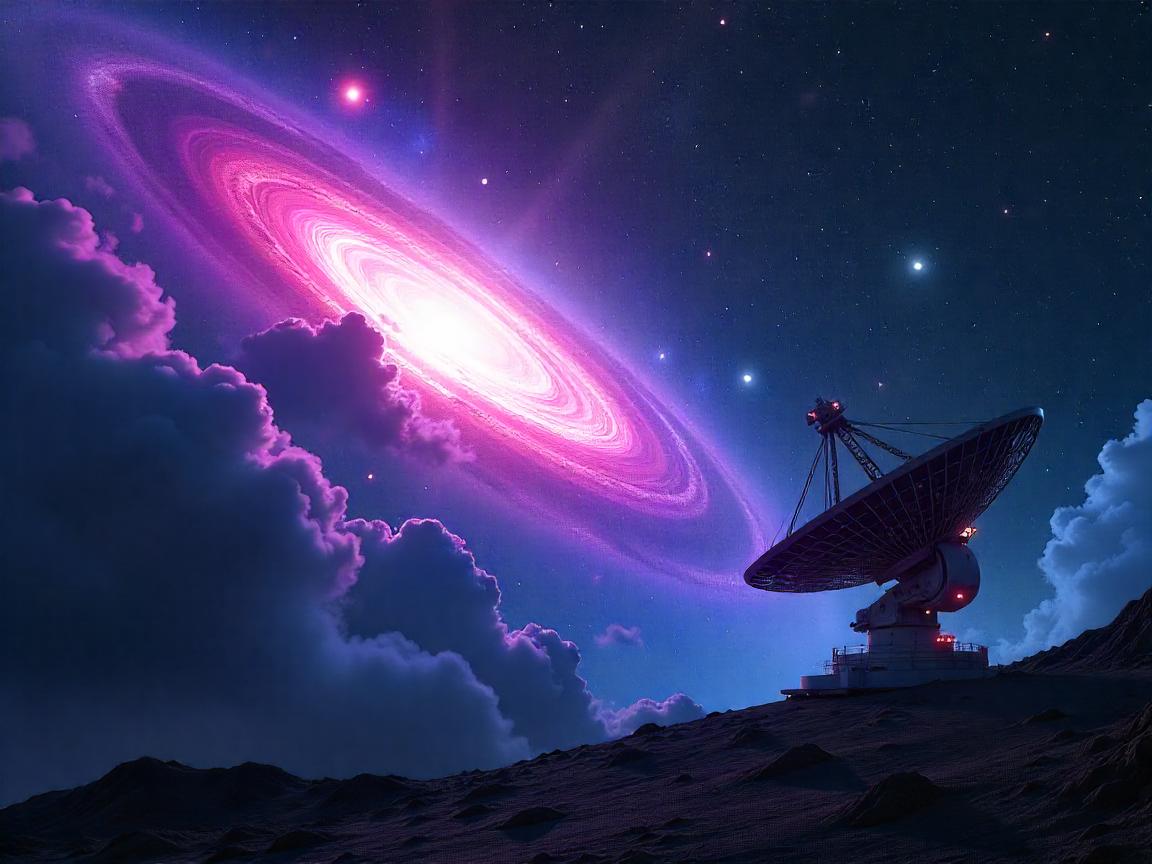
Think of a signal beaming out of some distant point in the universe-but so bright it would make galaxies appear as dim points of light, and which only lasts a handful of milliseconds. And picture now that it repeats, capriciously, breaking every known and defended cosmic law. And that is the mystery of Fast Radio Bursts (FRBs), and astronomers are working desperately to solve it after the latest repeating FRB has put all the former presumptions to stop.
Most FRBs were believed to comprise one-off cosmic accidents; colliding neutron stars, death of magnetars, or other cosmic cataclysms, over years. However, a small number of them have been repeated, and now the reason that scientists suspect is, because of their recent detection. What are their causes? Are they signals, natural happenings or something broader than our present day physics?
Fast Radio Bursts: A Cosmic Whodunit
FRBs are few not only in numbers, but also raving lunatics. In less than no time, a single burst may release as much energy as the Sun in 80 years. A majority of them disappear without trace, but some, such as the well-known FRB 121102 re-appear repeatedly.
The latest head scratcher, FRB 20240114A which was recently observed with the CHIME telescope in January 2024, does not happen in the usual script. It transmits but in unpredictable bursts in comparison to other repeaters who are predictably repeating and silent items- sometimes quiet during weeks, at other times hit by several signals in one day.
Dr. Amanda Smith (MIT Kavli Institute) says it in simple terms:
It is not just a magnetar hiccup. Only the pattern indicates a more complicated possibility–perhaps something we do not even yet have a category of!”
Breaking the Rules: What Makes This FRB Different?
- No predictable schedule: The schedules of most repeating FRBs are loose. This one? Totally random.
- Frequency Drift: the signal moves through radio bands in a manner that is never seen before or felt before as its signal slips through radio bands.
- Location Mystery: It would appear that the triangulation answer points toward a far dwarf galaxy but why is that so?
A 2023 paper in Nature suggested that certain FRBs might consist of some star spinning at high rotation whose magnetic field is very intense known as cosmic lighthouses. This new repeater? It is a lighthouse spelling out Morse code, and then suddenly turning off, without any conclusion.
Case Study The Wired Magnetar
There is the example of a magnetar in our own galaxy (SGR 1935+2154) which produced an FRB like signal in 2020. Scientists believed that they finally got the puzzle figured out, but found out that the vast majority of FRBs are much stronger and further. This new repeat only worsens the gap.
Are We Missing a Piece of the Cosmic Puzzle?
The most popular theories are:
- Magnetar Storms: It is perhaps the case that young, hyperactive magnetars release one-off bursts.
- Black Hole Interactions: Gravitational Waves of a Neutron star orbiting a black hole?
- Exotic Physics: Are there possible axion stars, or quantum dynamics?
The twist: A 2024 preprint paper argues that lightweight Fast Radio Bursts may be intergalactic shockwaves: plasma being smashed into by cosmic debris at close to the speed of light. Even that does not not quite explain the strange behavior of the new repeater.
The Hunt for Answers: What’s Next?
The Square Kilometre Array (SKA), scheduled to be activated in 2028 will cover the sky with unrivalled accuracy. In the meantime, real-time AI-powered sifting of radio noise is being carried out on projects such as the SETI COSMIC.
Would citizen scientists be an aid?
- Einstein@Home allows the volunteers to study and analyze FRB at their homes.
- Thousands of signals have already been classified in the Zooniverse Radio burst Zoo.
Final Thought: A Universe Full of Secrets
FRBs are the perfect reminder of just how much we do not understand. They might be natural, artificial or something we are not able to imagine. Nevertheless, there is no doubt that the universe is a mystery-loving creature.
What do you think? An accident of the universe?–or more? Eyes up to the skies.
Aliens? Probably not. But a new cosmic phenomenon? Absolutely mind-blowing.”