The Pyramid’s Last Secret: Why This Discovery Changes Everything
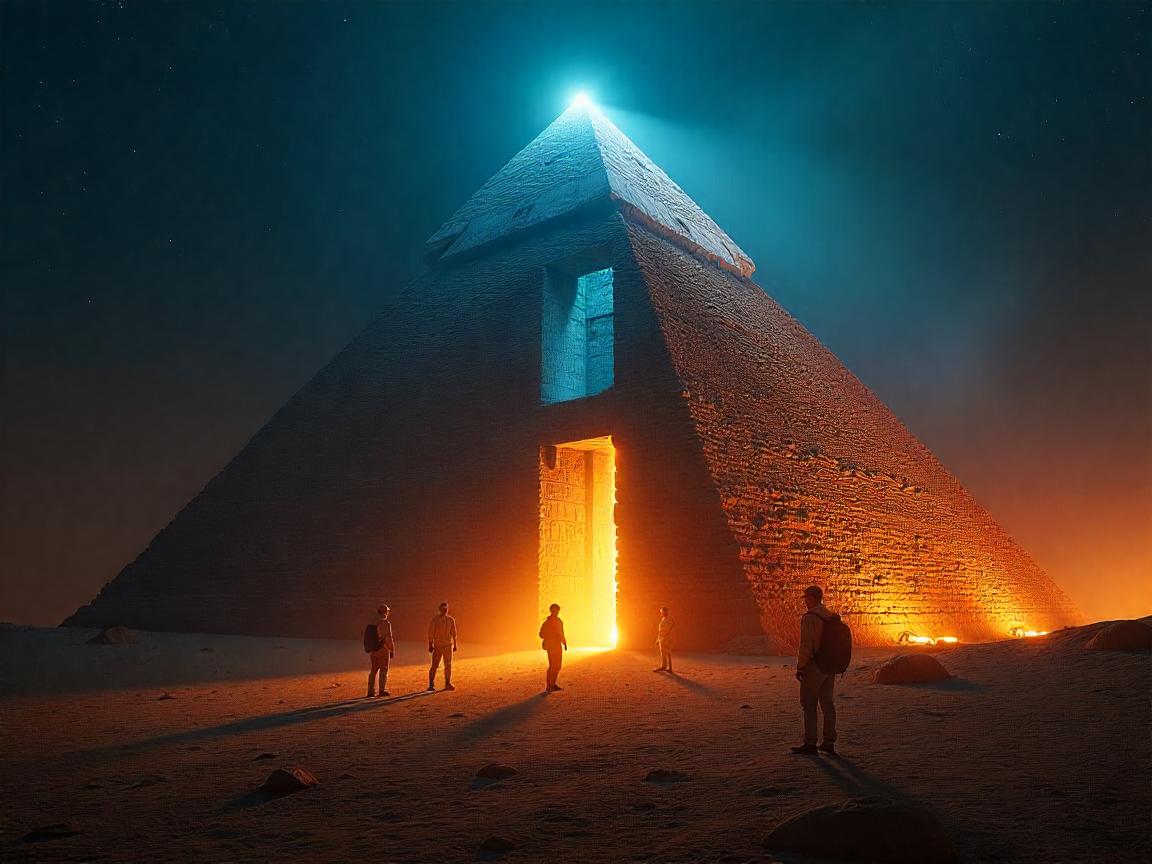
Millennia, we have been looking at the Great Pyramid, but still, it does not want to surrender all the secrets. When we thought we knew every corner, fresh obscure holes have been discovered in the depths of its ancient stones by the innovative scans of top-of-the-line muon tomography. It is no mere archaeological epilogue, it has the potential to be the roll of dice. Are there lost artifacts of Pharaoh Khufu in these secret places? Or is it a peculiar stroke of architecture to rewrite history?
The suspense is not novel. In 2017, the ScanPyramids project astonished the world and it uncovered what is called the Big Void: a dramatic cavity of 30 meters located above the Grand Gallery. However, the recent 2024 examination that was performed with ultra-precise muon cameras shows that there is more, even much more. Researchers are talking because of two new anomalies, one very close to the entrance, and the other more inside the structure. Outside of these being gaps due to erosion or settling, what are they?
Muon Tomography: The Cosmic Ray Key to Ancient Mysteries
What about a variation of X-ray, only in this case you send in high-energy cosmic particles, which can penetrate through hundreds of feet of solid rock, rather than Chichi weak hospital beams. That is the moron tomography -a ground-breaking technology that is penetrating the hardest objects in the entire world. Muons which are generated during the collision of cosmic rays with the atmosphere of the earth travel through matter at different speeds. The dense rock absorbs them whereas the empty spaces do not. Scientists can get a look into pyramids, volcanoes and even nuclear power plants by imaging where they leak through.
This does not happen in theory. The power of the method was depicted in 2023 when hidden chambers under the Pyramid of the Sun in Teotihuacan were revealed through muon scans. Two new hollows in the Great Pyramid have been identified now with new detectors in Egypt. One coincides suspicious with the downward passageway- is it a walled up original entrance? The other, farther in, corresponds to nothing structural.
What is significant about that?
- It is believed that all the design of the pyramid was charted. These gaps tell us that we have omitted something huge.
- There has never been any pharaoh found inside. Is Khufu sarcophagus in plain view?
- In case of being intentional such spaces may hide some unknown methods of constructions, or even their purposes which are symbolic.
Inside the Debate: Accident or Hidden Treasure?
Not all people are convinced. Dr. Statement by the former antiquities minister of Egypt Zahi Hawass suggests that these holes might be natural cavities due to settling or incomplete construction. He notes that the pyramid is 4,500 years old. Not all air is an orifice.
It is not only the voice of skeptics. Engineer Robert Bauval, co-author of The Orion Mystery, has indicated the almost perfect tally of blank spaces with known passages. He says, the builders did not do random. There is a reason, at the least, that happens to be empty.
And of course there is the wild card theory: acoustic resonance. Other scientists such as Dr Carmen Boulter (University of Calgary) also believe that the pyramid was perhaps constructed to allow the transmission of sound waves in a ritual manner. would these empty spaces magnify the frequencies that are hidden? Without physical exploration, the guess is on us.
The Ethical Dilemma: Should We Drill—Or Back Off?
It is at this point where the thorns furnish. In 2010 the Djedi Project launched an inch-wide robot into a crevice at the bottom of a narrow shaft, exposing hieroglyphs that had not been seen in thousands of years. The world can use even more than micro-drones could accomplish today. However, UNESCO cautions against drilling in the protected World Heritage. And make one mistake, and we can have the destruction of history that cannot be replaced.
Case Study: Humidity changes destroyed pigments on the walls in Tutankhamun tomb when researchers drilled into it in 2015. The lesson? There is a price to be paid sometimes when one is curious.
However, will the secrets of the pyramid remain buried forever since we never go in there to find out? Dr. Alan Bross, an expert in muon imaging, proposes to compromise: nanocameras on fiber-optic fibers–minimal invasion, maximum knowledge.
Final Verdict: The Pyramid’s Choice—Not Ours
The Great Pyramid was not created in one day, and its secrets are not going to be solved in one day as well. But the question here is, are we given the right to find out all? There is a possibility of some mysteries being supposed to last.
Your guess?
- Is it worth a risk to explore?
- Or doth not some history profit not to touch?
Take your mind down-ards–the past doth hearken.