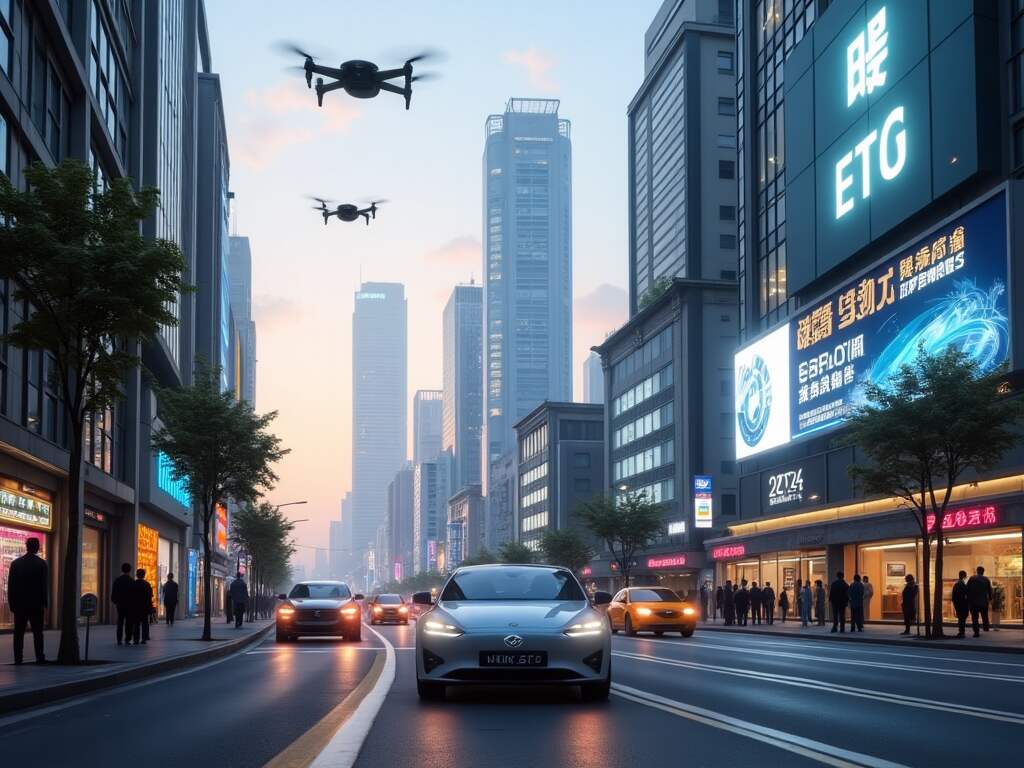
From Electric Dreams to Robotic Realities
China’s EV dominance: The world once regarded China as a factory floor of globalisation not so long ago. Such a country is now leading in the industries of the future. The Chinese emergence in the electric vehicle (EV) market did not only raise eyebrows, it blew off perceptions. BYD now ranks ahead of Tesla on a worldwide EV sales, selling more than 3.6 million in 2024, and NIO, XPeng, and Li Auto have been actively developing their presence abroad. What is interesting is that such EV boom is adding further fuel to another equally radical industry: robotics.
To find more, it will be obvious that both EVs and robotics use identical technological DNA. Batteries, sensors, highly intelligent AI processing and lightweight manufacturing are just as important to a humanoid robot or a drone as they are to an electric vehicle. And hence is it really a surprise when companies such as BYD and NIO are already tilting into robotics and aerial mobility? In the case of China, it is not as though they are diversifying– it is a natural process.
EV to Robotics: The Shared DNA of Innovation
Batteries are considered a core of EV and autonomous robots. Its leadership in lithium iron phosphate (LFP) batteries (which it has developed and optimized with BYD) is helping China take an early lead in robotics. These batteries are less dangerous, have lower cost, they are scalable in contrast to nickel-based competitors. Shenzhen-based robotics startups have already started to implement the battery packs produced by BYD into the next-generation delivery robots and drones.
There is yet another level behind the energy storage, and that is the AI software stack. The NIO Pilot is NIOs own autonomous driving system based on the Nvidia Orin chips and is currently tested on mobile robotics platforms, adapted to industrial logistics. When I was in Shanghai, engineers told me that the perception models they had developed to recognize lanes and pedestrians and traffic lights on cars are being reconfigured to detect warehouse shelving and moving forklifts and co-workers. It is a solid indication that innovation does not occur in a vacuum.
The Rise of Autonomous Systems and Aerial Mobility
Aerial mobility may be one of the least-discussed elements in Chinas robotics drive. One of XPengs affiliates, XPeng AeroHT, has already test-flown its eVTOL vehicle in the city of Guangzhou and is scheduled to commercialize this within the next three years. BYD, in turn, has been rumored to be working on autonomous drone-based logistics to supplement its EV line-up, potentially pushing to employ autonomous and manned drones to deliver high-value products and even passengers.
The most interesting part of it is that these trials get normalized in Chinese cities. The regulatory sandbox in Shenzhen has already had delivery robots and autonomous taxis running on the streets. The city is expected to issue more than 50 pilot permit of the robotic and autonomous systems in 2025 alone as per the ministry of Industry and Information Technology (MIIT). Compare that to the U.S., where regulators are still struggling to contend with safety frameworks as regards self-driving cars, much less flying robots.
In other words: China is not taking permission. It is real time deployment, learning and iteration. The latter feedback loop may be decisive.
Global Competition: Can the West Keep Up?
Like any time we mention robotics, we must mention the comparison to the Optimus Tesla humanoid project. Yes, Elon Musk has made his robot a headline, but, Chinese companies are gaining speed under many aspects. Humanoid and quadruped robots are already commercially available on their respective platforms used by Fourier Intelligence and Unitree Robotics, China, respectively. Their robots have a cheaper price and they are manufactured on a volume that Western competitors cannot keep up.
The figures are mind boggling. According to the International Federation of Robotics (IFR), in the year 2024, China installed more than 290,000 industrial robots, which constituted more than half of all robots installed worldwide. In Europe, there was comparatively only 78,000. Another 46,000 adherers were left behind in the U.S. The tariff standoff with the Chinese on EVs is heating up in the West but the robotics battle is happening out of sight.
Being a reporter in tech industries in Silicon Valley and Shenzhen, I cannot but to see the discrepancy in the thinking. The American companies like to pursue breakthrough moonshots, Chinese companies focus on iteration, scale and ruthless reduction of the price. That practical model could prove just the concept in robotics.
Expert Insight: The EV-Robotics Feedback Loop
To illustrate the point about ROVs, one robotics venture capitalist in Beijing summed it up well: Every yuan that is put into EVs is a yuan put into robotics by proxy. His point? The EV motors are made in the same factories which make robotic actuators. Power systems to drones and humanoids can be shipped via the same supply chains that ship EV-grade batteries.
It is therefore a feedback loop with one area of growth causing the other to grow faster. For example:
- BYD research and development team have now miniaturized the Blade Battery technology used in their EVs and are now producing them in drone form.
- The autopilot algorithms of XPeng are being tested in mobile robots as a last-mile delivery device.
- Factory automation applications are present in NIO LiDAR systems designed to be used in cars.
It is strategic leverage, not technology synergy. And as the Made in China 2025 policy in Beijing explicitly counts robotics and EVs as twin pillars, the wind is bureaucratic as well as industrial in girth.
Challenges and Overlooked Risks
Naturally, it does not go well all the time. Chinese robotics is confronted with real challenges. Security is an enormous question. An incident of a humanoid robot malfunction in a Shenzhen factory last year has generated an industry-wide conversation around fail-safes and liability. Regulation hangs over like a cloud too: with the robots leaving the factory and entering the streets issues of privacy, surveillance and the disruption of labor will become even stickier.
Another risk is played out in geopolitics. Tariffs against Chinese EVs because of unfair subsidies have already been imposed by the U.S. and EU. The next similar limitations on robotics exports or AI chips may follow. China and the West are on a path toward a robotics decoupling, in which both ecosystems devolve to (more or less) incompatible environments, as has occurred in 5G and in semiconductors.
And not to mention cultural factor. What is the likelihood that Westerners will accept Chinese humanoids in the work environment or their homes in large numbers as they did the smartphones? It is still not obvious.
Conclusion: The Next Global Tech Battlefield
The Chinese dominance in EVs was just an act of ovation. Robotics is turning out to be the sequel and the stakes are higher than ever. The manner in which we work, move, and live is soon to be written differently through the machines that walk, fly and think with us.
The actual problem is whether the remainder of the world are going to be capable of keeping pace and up with the pace and the magnitude of China. Like EVs will transform the global automotive industry, robotics may transform our economy of work. Unless competitors do more, China may not only dominate this revolution, it may also dictate the rules of that revolution.
Then ask yourself: Does anyone want CHINA to build a robotics future, or does anyone want the world to collaborate in a balanced form? The time is passing by.