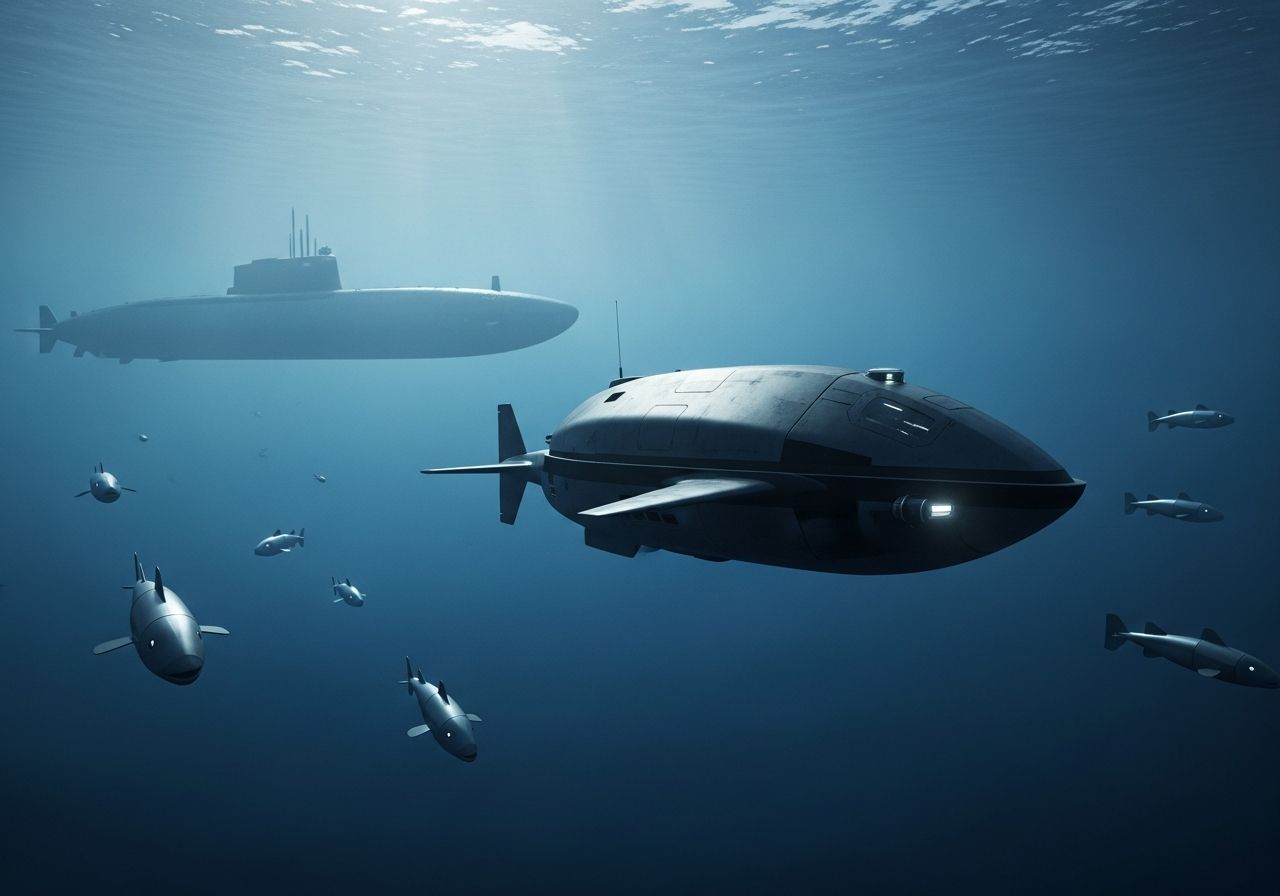
Have you ever imagined what a new cold war would be like? Forget nuclear silos. The coming big battle is being fought under the silent and crushing blackness of the deep sea. At the present, China is using underwater robot armies. This isn’t science fiction. It is the strategic, overt, and well-invested push of dominance that is causing US admirals to feel the real concern. It is time to explore what is actually going on.
Robotics are used to construct the Great Underwater Wall
It is not merely the plan of China to construct additional submarines. They are building a white-collar fortress. The plan is also known as the Great Underwater Wall with the view of establishing a massive sensor-sensitive land. It is an area covered by self-driving drones.
These are the systems protecting the South China Sea. They also have a long distance projection of power. In 2023, the Pentagon report affirmed that China has the largest marine militia in the world. Unmanned vessels are currently being added to this fleet. This is aimed at achieving complete situational awareness. And they are throwing billions to get there.
- The underwater testing of drones has never been as massive as it is currently, according to one US Navy Admiral. We track their naval growth. But their program in Robotics is quicker.”
Introduction to HSU-001: The Silent Workhorse
What then are the appearance of these machines? Take the HSU-001. This unmanned underwater vehicle (LDUUV) is a good example. It’s over ten meters long. It is rather like a little submarine. Analysts are of the opinion that it works as a submarine spy.
Its mandate is long-range intelligence collection. It is able to chart the ocean floor months. This data is priceless. It assists the Chinese submarines in navigation. It also finds hiding spots. This is a direct threat to the US nuclear stealth. The HSU-001 isn’t alone. It belongs to an extended family of sea-going robots.
A Swarm of Robotic Fish
However, what is even smaller is the actual game-changer. Suppose a school of robotic-fish. They make a silent entry in a foreign naval port. They are fitted with sensors and cameras. These drones are bio-inspired and hardly noticeable.
They are the transition to distributed AI Robotics. Why expend money on a single costly submarine? Instead, you can launch a thousand low-priced smart drones. Everything is different with this swarm mentality. It submerges conventional fortifications. It is a cheap method of challenging the seas.
The reason why the US Navy is Playing Catch-Up
The US is highly worried because of obvious causes. To begin with, these drones are an asymmetric advantage. The former are cheap and disposable. On the other hand, an aircraft carrier of the US is priced at 13 billion dollars. It would be taken out by a swarm of drones at a fraction of that price.
Secondly, they pose a risk to vital infrastructure. The internet that we all in the world operates on is undersea. These are delicate cables that are mostly unguarded. Underwater robots would be able to map, tap them or even cut them. This would lead to the economic anarchy all over the world without any shot being fired.
- An analyst of NATO was straight to the point: decades we have been gazing up into the skies to see what will happen to us. We are now actually weaker than we were before.
The Artificial Intelligence Brain That Powers the Fleet
It is not merely a hardware competition. It’s a software sprint. The most important element of this threat is sophisticated AI Robotics. These are not remotely operated machines. sophisticated AI Robotics take independent decisions. They sail through complicated streams. They do not get noticed on their own volition.
The technology is similar to DNA in terms of algorithms created in Humanoid Robot projects. The sense of touch and the ability of a Humanoid Robot to move around a cluttered room is comparable to what a drone requires to move around a coral reef. The investment of China in the general AI Robotics is directly injected into its military capabilities.
In the case study: invading with the Sea Wing Glider
Take a real-world example. In 2020, months of operation of a fleet of Chinese Sea Wing gliders took place in the Indian Ocean. They gathered the huge oceanographic information. This incident wasn’t a one-off. It was an exhibition of magnitude and stamina.
This is what is termed as the digitization of the ocean at work. Each drone is a data point. The combination of them creates a living, digital map. This provides a monumental home-field advantage to any navy. Even the ocean is turned into a weaponized territory.
Professional Testimony: A Changing Battlefield
I interviewed an ex- submarine sonar-man. He asked to remain anonymous. The sound of such things is not much, he said. We are conditioned to hear enormous, clanking contacts. These drones are more biologic. It is as if one is attempting to locate one particular fish among a huge school of fish.
This is a personal observation which points to the essence of the problem. We have made our whole defense policy on the basis of another type of war. We are ready to battle giants, not a swarm of insects.
The Last Word: Wake up and Smell the Saltwater
Undersea drone warfare is already here. China knows it. The US is scrambling to adapt. This algorithmic arms race will characterize maritime security in the coming century, which will be silent. The depths have got to be controlled, and so has the global economy. It is not a matter of who is the biggest navy. That is who owns the cleverest robots. We have to be more innovative or we will lose to a ghost fleet that we cannot even see or hear. The time for action is now.