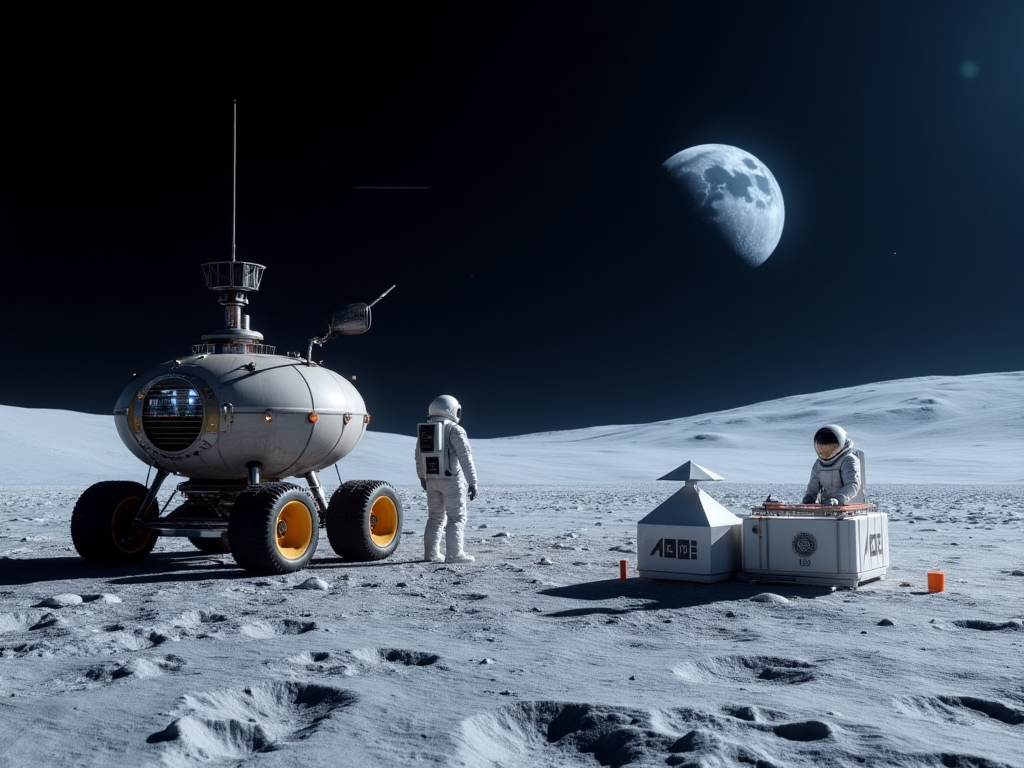
Introduction: The New Moon Rush
Think back when the Moon was only a dream? Hello, it is a geopolitical chess-board and China is taking a gamble. As Artemis creeps towards NASA achieving the possibility of landing astronauts on the Moon, the Chinese mission of Chang e-6 has landed on the far side of the Moon, the first process of its kind. This is not only about the science but it is about control. Ice on the Moon has the potential to power future Mars exploration and those that mine it first possess the treasure chest to deep space.
The lunar programme of China has been a course in patience. Yet, ever since Chang e-1 completed its 2007 orbit, they have slowly plotted out their methodical advancement; landing rovers, returning samples and now setting its sights on the secrets of the far side. In the meantime, NASA crewed Artemis landing is delayed until 2026 or beyond. The point is not only when somebody will be there first, but what rules they will establish then.
Chang’e-6: More Than Just Rocks
Chang e 6 is not a typical sample-return. It is drilling to the South Pole-Aitken Basin of the Moon which is much older than dinosaurs on the earth. The goal? Find out what makes the near and far sides of the Moon so dissimilar. Initial evidence indicates there was volcanic activity and ancient impacts have rendered the lunar history lopsided- which Chang e-6 may rewrite.
The thing is, however, that with China the technology is ahead of expectations. They have autonomous landers that not only land: they steer through boulder fields, bore down 30 feet, and re-launch samples back to Earth. Contrast that to the recent lunar travails of NASA (see: Astrobotic: Peregrine lander fails). One space observer explained: “China is playing the long game. Any successful operation brings one closer to permanence.”
Key Takeaways:
- The first-ever far-side sample return.
- Clues to the violent past of the Moon exist in South Pole-Aitken Basin.
- The successful three out of three lunar landing incursion as executed by China since 2013.
The Geopolitical Moon Landing
The space race that came during the cold war was all about prestige. Power is the race of today and China is making a heavy bet. The U.S. is trying to mobilize its allies to the cause of the Artemis Accords (36 signatories, lacking China and Russia), however, Beijing is assembling its own coalition. A joint Russia effort with them is the International Lunar Research Station (ILRS), which is to have a manned station by 2035.
So what? The space exploration oil is lunar water ice. It could reduce Mars mission costs to a third by being converted into hydrogen fuel. Chinese early presence might allow them to de facto control good real estate. Just imagine it as the Antarctica, but with less treaties, and rockets.
Expert Insight:
Some 240 miles above the Indian subcontinent, director Namrata Goswami, a space policy scholar at the U.S., says, “The U.S. considers itself to be the automatic space leader.” China does not see it that way. They are not only planting flags but rather are establishing infrastructure.
Science in the Shadows: The Far Side’s Secrets
The other side of the Moon is the scientific motherlode. It is free of radio noise on Earth and thus ideal to radio telescopes. The 2019 landing of Chang-e4 showed some weird gel-like (currently known as impact glass) material- only the beginning of what lies concealed.
However, there is the snag that radio contact cannot be made to the Earth without direct line of sight, and the relay satellites come into play. That is solved by Queqiao-2 launched by China this March. It resembles constructing a lunar Wi-Fi network prior to the occupancy of the neighbours.
Case Study:
When the Chang-e-5 probe returned samples in 2020, researchers discovered young volcanic rocks-Only 2 billion years old. That redefined the theories concerning the thermal evolution of the Moon. Just consider what might be seen of far-side samples.
The 2030 Deadline: Bases, Bots, and 3D-Printed Habitats
Considering how staggering is the roadmap of China:
- Chang e -7 (2026): Imaging water ice with a rover.
- Chang e -8 (2028): Threedimensional printed structure made out of lunar material.
In the meantime, the crewed landing of NASA Artemis III is in a slip. Its lunar lander, the Starship manufactured by SpaceX, has not been tested. Any delay may only mean that the United States sits back and watches China build.
Personal Take:
This can be interfered with by the likes of SpaceX. Will Musk move to China when NASA falls? Politically that was unrealistic-but in space, pragmatism tends to triumph over patriotism.
Conclusion: Who Writes the Rules for the Moon?
And here is how it makes you squirm: space law is fuzzy. The 1967 Outer Space treaty prohibits national lay claims, but nothing related to extraction of resources. A South China Sea-type of action is possible: China occupies and leaves others to come and dispute it.
Artemis will take either the Moon or a much faster West. Since in this second space race second place does not merely mean losing, rather, it means being locked out altogether.
Final Thought:
It is not a trophy of the Moon. It is a train going out of the station. At this point, China is awowing the conductor hat.